

Making sense of the markets this week: July 16, 2023
Kyle Prevost, editor of Million Dollar Journey and founder of the Canadian Financial Summit, shares financial headlines and offers context for Canadian investors.
Hello again, MSOTM readers. I’m back from an all-too-brief summer vacation, and I’m ready to zero in on where the markets are headed. A big thanks, as always, to Dale Roberts for pinch-hitting while I was away.
Canadian mortgage holders suffer another rate hike
The Bank of Canada (BoC) delivered another widely expected 0.25% interest rate hike on Wednesday. The last time interest rates were this high was April 2001. Beyoncé was still fronting Destiny’s Child and this year’s recent college graduates weren’t even born yet.
On Wednesday, BoC governor Tiff Macklem stated, “First, monetary policy is working, but underlying inflationary pressures are proving more stubborn.” He added, “Second, we are trying to balance the risks of under- and over-tightening monetary policy.”
It appears that most traders and analysts now believe an additional quarter-point increase is coming in September, before the BoC pauses rate hikes again.
Equity markets appeared to take the news in stride on Wednesday, as the S&P/TSX Composite Index was up nearly 1%.
While savers have much to celebrate these days, borrowers are not so cheerful. The prime rate of interest that financial institutions charge their customers is now likely to go up to 7.2%. Mortgage borrowers are paying 29.9% more in interest costs than they were a year ago. For a new home buyer with a mortgage of about $676,000, every 0.25% interest rate increase means about $100 more paid in interest each month. Consequently, if rates are raised again in September, folks with new variable-rate mortgages could be paying well over $2,000 more per year than they were in June.
Car loan borrowers are feeling the pain as well. Gone are the days of 0% interest incentives. If you were to take out a seven-year $40,000 auto loan at 7.5%, you’d be looking at paying over $10,000 in interest.
Markets celebrate lower U.S. inflation
U.S. markets hit their highest level in more than a year on Wednesday after the Department of Labor’s consumer price index (CPI) showed a continued downward trend. (All figures in this section are in U.S. currency.)
One year after U.S. inflation hit a 40-year high of 9.1%, it has now come back down to 3%. Some quick takeaways from the June 2023 Consumer Price Index report:
- Gas prices down to about $3.50 from a high of $5 last year
- Core inflation is still stuck at 4.8%
- Housing prices up 7.8%
- Egg prices (which skyrocketed earlier this year to $4.82) down to $2.67 per dozen—of course, that’s up from a pre-pandemic price of $1.60
- Services, such as restaurants, child care and dental services, saw quickly rising costs
- Auto insurance on average 17% higher than a year ago
Also interesting, the state with the highest inflation was Florida. And perhaps most notably, for the first time since early 2021, the growth for U.S. wages eclipsed CPI inflation.
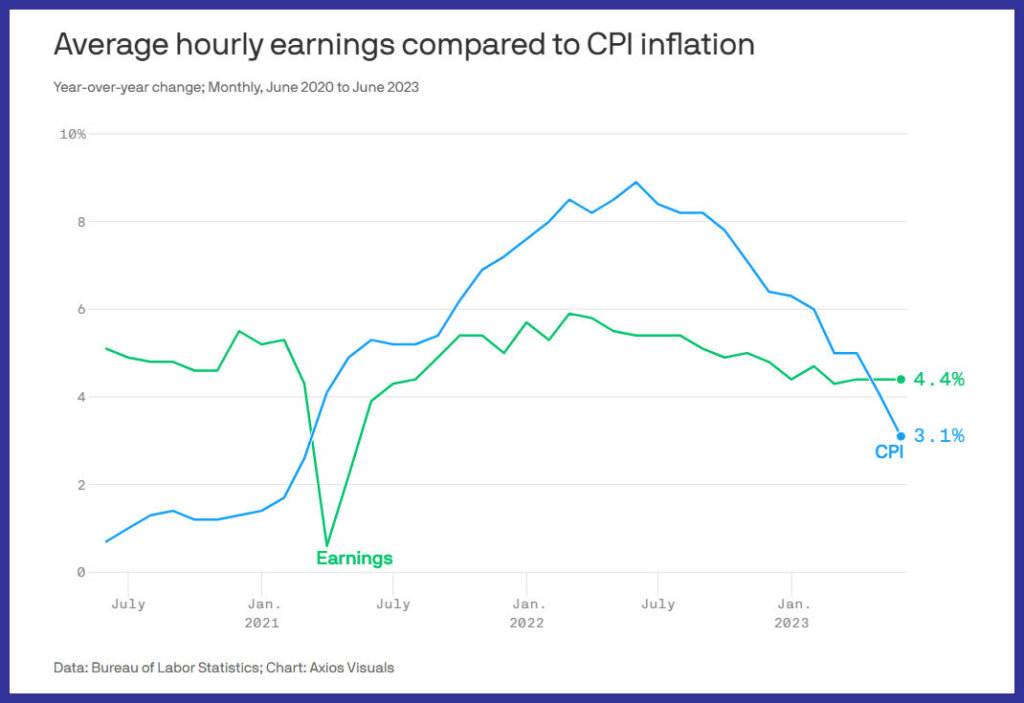
Given the mostly positive economic data this month in the U.S., there is about a 95% chance the Federal Reserve will follow the BoC in raising interest rates later in July, but only a 10% to 15% chance that they get raised again in the following months.
In other words, the market watchers are seeing the light at the end of the tunnel. They’re looking forward to a time when interest rates aren’t just staying “higher for longer” but might even begin to come down. Of course, it’s worth considering the possibility that investors saw the end of the tunnel a while ago, and the good inflation news has already driven valuations higher. If that’s the case, sub-3% inflation has already been “baked in” and won’t contribute much of a tailwind going forward.
Passive investing is here to stay
Visual Capitalist recently gave us a look at the 2022 market share of the world’s large fund providers and their respective growth rates. (All figures in this section are in U.S. currency.)
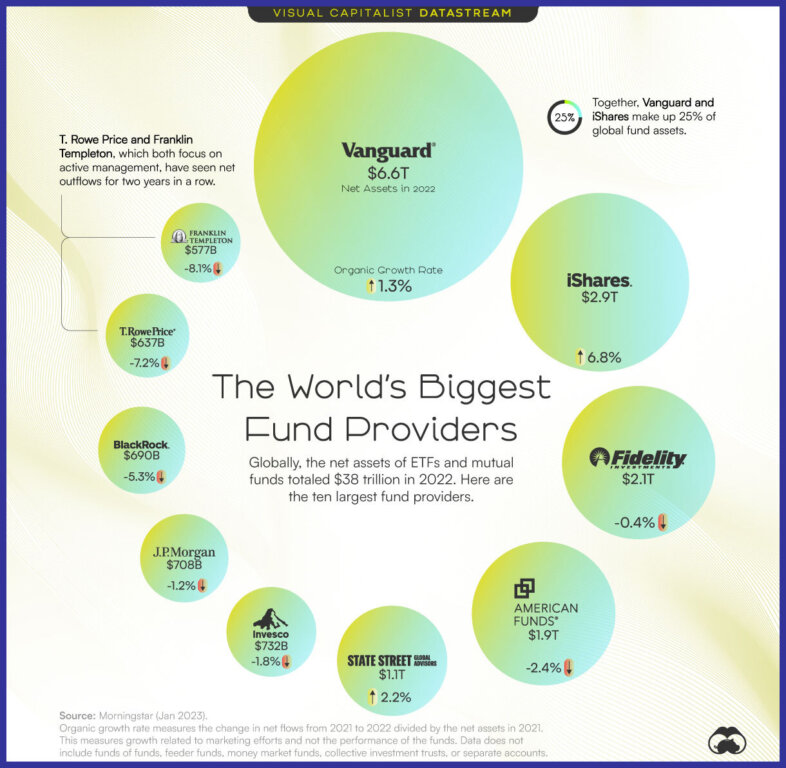
When you consider the behavioural tendencies of investors to sell when the going gets tough, these numbers were actually much healthier than one might have predicted. No surprise here that fee-friendly Vanguard continues to have a massive lead on competitors.
The even more compelling data in the notes section of the graphic reveal that in 2022:
- Mutual funds net outflow: $1.3 trillion
- ETFs net inflow: $754 billion
- Actively managed funds net outflow: $349 billion
- Passively managed funds net inflow: $348 billion (these account for 38% of global assets, up from 19% a decade ago)
Taken in their totality, this data shows a strong trend toward cheaper and more passively managed investments. Given that the average management expense ratio (MER) of an actively managed equity mutual fund in the U.S. was 0.66%, and that the average MER in Canada is closer to 2%, Canadian fund investors have even more reason to make the switch to cheaper options.
Pepsi earnings give shareholders a sugar rush
Beverage and snack behemoth Pepsi posted an earnings beat on Thursday. (Figures in this section are in U.S. currency.) Earnings per share came in at $2.09 (versus $1.96 predicted) on revenues of $22.32 billion (versus $21.73 billion predicted).
Decreased beverage sales volumes were more than offset by raised prices, and Pepsi executives shared that volume was actually higher than expected, due to low global unemployment. Consequently, the company increased its full-year revenue and profit projections.
Doritos and Ruffles were the surprise performers of the quarter for the company, as the new “Flamin’ Hot” flavour helped to increase sales growth by double digits.
Delta earnings are cleared for liftoff
Delta also posted excellent quarterly earnings on Thursday. In fact, they were the highest revenue and earnings numbers ever for the airline company. (Figures in this section are in U.S. currency.) Earnings per share came in at $2.68 (versus $2.40 predicted) on revenues of $14.61 billion (versus $14.49 billion predicted).
International travel and increased revenue from premium seats led the way on the revenue side of things, while decreased fuel costs helped buoy the bottom line. And, Delta CEO Ed Bastian stated, “I think the trends that we’ve seen this year are going to continue.”
Oh, and remember when everyone was predicting a recession in 2023? Someone should have told all of those international first-class travellers that they were supposed to stay home due to financial panic.
You can check out our article on Canadian airline stocks and ETFs at MillionDollarJourney.com for more information on investing in travel.
With earnings season in full swing next week, there will be no shortage of market news to keep up with.
The post Making sense of the markets this week: July 16, 2023 appeared first on MoneySense.
No comments