

From groceries to flights to mobile data: Why is Canada so expensive?
The cost of living in Canada is high and getting more expensive by the day. Canadians pay above-average prices for a number of goods and services—from groceries to flights and cell phone plans. And inflation has remained high since the COVID-19 pandemic, making Canada even more expensive.
That doesn’t mean everything costs more in Canada, says David Soberman, a professor of marketing and Canadian national chair of strategic marketing at the University of Toronto’s Rotman School of Management. Canadians may pay more than Americans for the same basket of goods, he says, but we pay less than people in some other countries, like Switzerland.
Why do we pay what we do? That’s a difficult question to answer. The reasons are complex and vary depending on the type of good or service. Let’s look at some of the main contributors to Canada’s cost of living, why they are as expensive as they are, and steps you can take to reduce those costs.
Why are groceries so expensive in Canada?
There are a few reasons groceries cost so much in Canada, says Soberman. It’s expensive for companies to ship food products across a country as large as ours, and those costs are reflected in what you pay in stores, he says. But a highly concentrated grocery industry is also a big contributing factor.
Canada’s grocery market is dominated by just a few companies. Domestically, there are three big players: Loblaws, Metro and Sobeys. (Some chains, such as Save-On-Foods in Western Canada, compete on a regional basis.) The next largest retailers for grocery sales are Walmart and Costco. Together, these five companies account for more than three-quarters of all food sales in Canada, according to Canada’s Competition Bureau. In 2023, 49% of Canadians report buying groceries from Loblaws or one of its sister stores.
Critics argue such concentration allows the dominant companies to participate in anti-competitive practices that ultimately harm consumers through higher prices. In grocery, this takes the form of fixing bread prices, preventing competitors from selling certain products, or collectively deciding when to freeze grocery prices—and when to unfreeze them. It’s a problem experts say applies to other industries, such as telecommunications and air travel.
When Canada’s Competition Act was introduced, in 1986, there were at least eight large grocery chains in Canada, each owned by a different company. Since then, more than a dozen major mergers and acquisitions have reduced the level of competition. Today, three big supermarket companies own several smaller chains, including discount brands that could be mistaken for rivals: Loblaws has No Frills, Sobeys has FreshCo and Metro has Food Basics, for example.
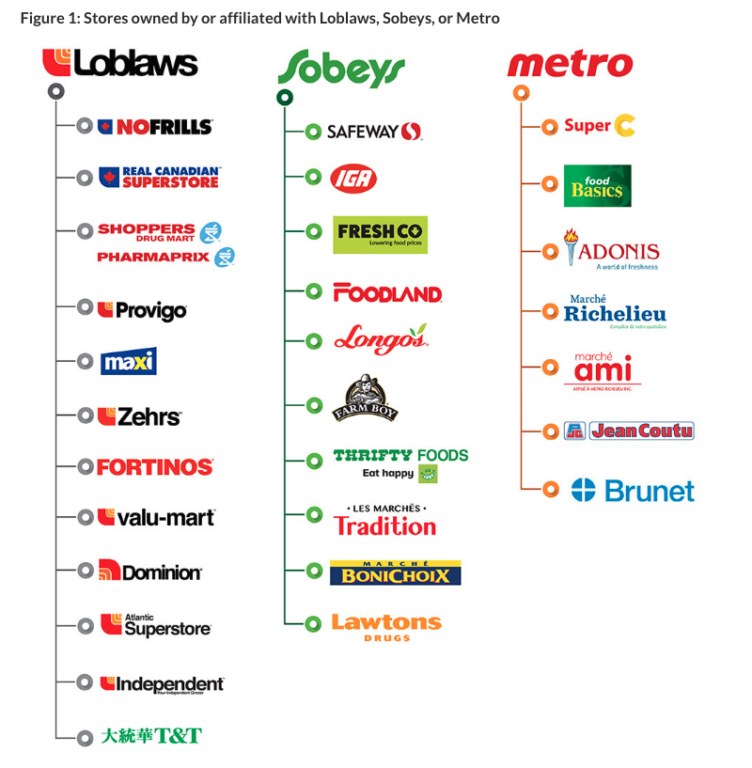
How does Canada allow for three big grocers to reign? “The law in Canada typically will not allow the Bureau to intervene in these deals, as they are generally seen as unlikely to have a significant impact on prices and other dimensions of competition,” states a Competition Bureau report. “In the case of a major city or suburb, with five or six different grocery stores nearby, it can be hard to prove that removing one option will cause prices to go up significantly.”
Another underlying issue is that, for many decades, the prevailing view was that “as a small, but large country, we need to accept lower levels of competition to achieve a scale that is necessary to serve the various markets,” says Keldon Bester, executive director of the Canadian Anti-Monopoly Project (CAMP). Over time, that belief has led to fewer and fewer options for consumers, he says.
In European countries, the largest grocery companies compete against standalone discount grocery chains, such as ALDI and Lidl. Research shows these stores have created more choice for consumers and ultimately forced a reduction in grocery prices at other chains.
But does little competition actually lead to higher prices? The heads of the Canadian grocery companies say runaway grocery costs are the result of inflation, supply chain challenges and supplier requests to raise prices.
While there’s truth to that, the Competition Bureau says the largest grocers have also increased the percentage of profit they earn on food products over the last five years—so, before the onset of inflation and supply chain issues.
Compared to 2017, supermarkets generally make $1 to $2 more on each $100 that Canadians spend on groceries (an increase of 1% to 2%), according to the Bureau. Canadians spend an estimated $110 billion on groceries each year, so a 1% increase would add about $1 billion to Canadians’ food costs, it says.
The federal government wants grocers to work together to tackle rising food prices. It even wants to change the Competition Act to make it easier to intervene in mergers that could hurt competition. Under current Canadian competition law, decision-makers must consider “corporate efficiencies” when approving mergers, even if the deal could lead to higher prices and fewer choices for consumers.
“We have to demand that governments find a way to increase choice and competition, stop these big mergers, and stop these big companies from using their power to crush competition that could be beneficial to Canadians,” Bester says.
How to save on groceries
Short of taking a cue from the French (whose bread grievances helped kickstart the French Revolution), taking action on an individual level could entail speaking to your Member of Parliament about how you’ve been impacted by high grocery prices. (Earlier this year, Portuguese residents took to the streets to demand a cap on grocery costs.) You can shop local and support independent chains, when possible.
Beyond that, there are small steps you can take at home to start saving on groceries, such as having a clear grocery budget, meal planning before you shop and bulk buying certain items. Packing a credit card that offers rewards on groceries might be appropriate, too. Another big way to save: Cut back on food waste.
Why are cell phone plans so expensive in Canada?
When it comes to our cell plans, the issue is that “foreign competition has effectively been prevented from entering the Canadian market,” Soberman says, noting that the industry is dominated by Rogers, Telus and Bell. “Typically in concentrated industries like this, firms learn to avoid price competition, because in a price war, firms always lose.”
In 2023, 1 gigabyte (GB) of data cost an average of USD$5.37 in Canada (roughly CAD$7.50), making it the most expensive place in North America for mobile data, according to Cable.co.uk. That makes it the 20-second most expensive place for mobile data of all the countries analyzed. By comparison, in Israel, the least expensive country for data as of September 2023, 1 GB cost consumers USD$0.02 (roughly CAD$0.03).
But making cross-country comparisons is not easy, because so many factors need to be taken into account, argues Gerry Wall, founder and President of Wall Communications Inc., whose wireless pricing data is published on the Government of Canada website.
Wall’s company examines pricing for eight plan types with different talk, texting and data allowances. The findings are less black-and-white than when comparing prices between countries using a single data point, but they still suggest Canadians pay more than people in many other countries. (The range from one to eight is from most basic plan to most featured.)
“In general, across all plan levels, Canada tends to have higher prices than Australia, the U.K., France, Italy and Germany,” Wall says.
For example, in 2022, the average level-eight plan—one that includes unlimited nationwide talk and text and 50 GB to 99 GB of data—cost $101.74 per month in Canada. (All figures in Canadian dollars.) A similar plan cost $29.32 in Italy, $32.55 in the U.K., $38.99 in Australia, $40.39 in France, and $70.44 in Germany.
Canadian pricing is similar to what you’d find in Japan ($111.88 per month). Americans, meanwhile, pay much more than Canadians for low-level plans and slightly more for mid-level tiers. Wall notes there is no level-eight pricing data for the U.S. as most of its high-level plans come with unlimited data. Here’s a summary of the price comparisons, according to Wall Communications.
The cost of cell phone plans in G7 countries
There are parallels between Canada’s grocery and telecommunication sectors. The wireless market is dominated by three big national players—Telus, Bell and Rogers. And each own and operate lower-priced “flanker” brands (Koodo, Virgin and Fido, respectively) as well as no frills budget brands (Public Mobile, Lucky Mobile, and Chatr Mobile, respectively). This explains why Rogers’ acquisition of Shaw Communications, the previous owner of Freedom Mobile—Canada’s fourth-largest wireless carrier—came under heavy scrutiny this year.
But, Wall says the industry’s ownership structure in Canada (which is one driver of competition) is similar to what you might find in other G7 countries.
“Most countries we compare with Canada just have two or three major national mobile network operators providing service—the same or similar to Canada,” he says. “However, there are some differences in the role of mobile virtual network operators [MVNOs]—also called resellers—which are more prominent in some other countries.”
The “virtual” in MVNO refers to a company that rents or buys use of other operators’ spectrum and equipment, instead of owning towers. There are no purely wireless companies in Canada. In 2021, the Canadian Radio-television and Telecommunications Commission (CRTC) established a policy forcing the large companies to share access to their networks, which would allow regional carriers to act as MVNOs, with the goal of boosting wireless competition.
However, under the CRTC’s rules, only companies owning a network can operate as MVNOs; they must have their own spectrum license and they must plan to build a network in any new region they want to operate in within seven years. In essence, Canada continues to prioritize the need for physical infrastructure—which is a deterrent to creating a major competitor to the Big Three telcos.
Building infrastructure is costly for companies. And Canada’s geographical size and relatively sparse population makes it even more so. It’s an issue that affects not only telecommunications, but also Canada’s grocery and air travel industries.
Wall, however, is more hopeful about the future of the wireless industry in Canada. “Given that the Competition Bureau was only examining the mobile market [when reviewing the Rogers/Shaw deal], the outcome of having Freedom sold to Videotron was the best that Canadian consumers could have hoped for.”
As part of the deal, Rogers was forced to sell Freedom Mobile to Quebecor’s Videotron, and Quebecor (through Videotron, Freedom Mobile and its other brand, Fizz) will now be able to offer services using Rogers’ wireless network across Canada at rates determined by the CRTC. It previously only offered mobile service in Quebec and portions of Ontario.
How to save on your cell phone plan
If you want to save on your cell phone bill, Wall says regional providers, such as Freedom, tend to offer considerably lower prices than Rogers, Bell and Telus. Check out the plans from resellers, such as PC Mobile and Primus, which generally cost less, he says. And consider those from discount brands like Fido, Virgin and Koodo, which tend to compete with regional providers and resellers. “The best advice I can give is to do your research and shop around,” Wall says. “Better prices can be found.”
Why are airline flights so expensive in Canada?
Plane tickets are expensive in Canada for some of the same reasons your cell phone and grocery bills are high. Yes, I’ll say it again: There’s a need for greater competition. Air Canada and WestJet dominate the market, and it’s expensive for airlines to service communities across Canada. Routes between major Canadian hubs are unlikely to see the same volume of flyers as routes in Europe and the U.S. Sometimes it’s cheaper to fly to Europe or Asia than to the other side of Canada, depending on where you’re flying out of.
There’s another reason Canadians pay a lot for flights: airport fees. Simply put, it’s more costly for airlines to operate in Canada than other countries, and those costs get passed down to consumers.
Canada’s major airports are owned by the federal government and controlled by not-for-profit local airport authorities whose main sources of revenue are fees. The airports charge airlines for use of the gate and apron (the airplane’s parking area), security checks, navigation services, landing and airport improvement. While foreign airports often charge similar fees, they are much higher in Canada, according to a report in the Globe and Mail. Toronto’s Pearson airport, for example, “charges Air Canada about $1,500 to land a Boeing 737 Max, $7.49 for every domestic passenger on board and $2.91 for every minute the plane is at the gate.”
And, from there, the costs keep going up. In January, the Greater Toronto Airports Authority (GTAA) upped the passenger fees at Pearson by $5 to $35 plus tax. At the same time, it increased its aeronautical fees by 4%.
All told, after accounting for per-passenger fees, Canadian airport costs are 83% higher per seat than in the U.S., according to the same Globe article. And the various fees, charges and taxes passed on to consumers can represent roughly 35% of the total cost of a flight.
How to save on travel
While there’s nothing you can do to get out of paying these fees, you might still be able to save on your next flight. Choosing to travel during the off season (like the spring and fall) can save you hundreds of dollars. The same goes for flying with low-cost airlines, such as Flair and Lynx Air, but remember that you’ll have to pay for extras, like seat selection and checked baggage, when booking with these airlines. Making use of the travel points programs offered by travel credit cards can also help you fly for cheap.
What about the prices of gas, alcohol and other stuff?
There’s a reason we also pay a lot when we fill up on gas or stop by the liquor store, and it has little to do with competition.
In Canada, the federal government charges “excise” taxes on gas and diesel, alcohol, tobacco products, cannabis and vaping products, among other goods. Unlike sales tax, excise taxes are typically applied indirectly—meaning they are charged to producers and manufacturers, which pass the costs down to customers.
The Government of Canada also levies specialty taxes, in addition to the federal carbon tax whose costs are returned to Canadians in certain provinces and territories through climate action incentive payments (CAIP).
The goal of these taxes is generally to influence Canadians’ purchase decisions. Excise taxes, for example, are collected to raise revenue “while supporting public policy objectives such as reducing smoking or promoting environmentally friendly products,” according to the Canadian law resource Criminal Code Help. But the costs can add up.
The price of gas in Canada
On Oct. 23, 2023, the average price of gasoline around the world was $1.83 per litre, according to globalpetrolprices.com (all figures in Canadian dollars, according to the website). Canadian prices were not far from this global average, at $1.76 per litre. In comparison, a litre cost $0.04 in Iran, $1.38 in the U.S., $2.59 in the U.K. and $4.23 in Hong Kong (the most expensive place to buy gasoline).
So, it may be inaccurate to say gas is expensive in Canada, but the price we pay is largely influenced by taxes—one of the two big drivers of domestic gas prices, alongside subsidies. For example, Ontario drivers pay more than $0.33 per litre in combined federal and provincial taxes (including excise and provincial fuel tax) and carbon levies—before sales taxes.
The price of alcohol in Canada
The cost of spirits, wines, beer, coolers and cider are similarly inflated through federal, provincial and territorial taxes. The tax rates vary by province and territory and by the type of alcohol, with spirits being the most heavily taxed. But studies have pegged the total cost of excise and sales tax at 20% to 30% of final retail prices.
How to save on gas and acohol
To save on the cost of booze, skip the bar and enjoy your drink of choice at home instead (or, look for drink specials if you’re dining out). Buy from a duty-free shop (generally located near international land borders and airports) to save on import and sales taxes, and opt for domestic and low-cost over import and premium brands.
As for gasoline, remember that prices change daily and can vary from one station to the next. Monitor gas prices in your area before filling up. Developing eco-friendly driving habits, such as slowing down, breaking less and driving at a steady speed can also help you save at the pump. If your vehicle is not fuel efficient, make that a priority for your next ride. Another option: Go with a hybrid or EV. Though the upfront costs of some models are prohibitive, they are becoming more affordable and may help you save in the long run.
Why is Canada so expensive? Does it have to be?
There’s a host of reasons the Canadian cost of living is so high. And it may feel like there’s nothing you can do about it—modernizing Canadian competition law, for example, is something that remains outside of our individual control. Being aware of what costs more and why can help us make informed financial decisions. Beyond that, there are many steps we can take to manage the costs, from learning small savings hacks, being mindful about waste and the timing of your purchases, and embracing the search for a good deal.
Read more about Canada’s cost of living:
- How much does it cost to raise a child in Canada?
- How much can a landlord increase rent?
- How much should you tip at restaurants in Canada?
The post From groceries to flights to mobile data: Why is Canada so expensive? appeared first on MoneySense.
No comments