

Making sense of the markets this week: October 8, 2023
Kyle Prevost, creator of 4 Steps to a Worry-Free Retirement, Canada’s DIY retirement planning course, shares financial headlines and offers context for Canadian investors.
Lulu and Peloton are swolemates
Canadian athleisure giant Lululemon (LULU/NASDAQ) is teaming up with the formerly mighty fitness machine maker Peloton (PTON/NASDAQ). The deal, announced on Monday, detailed that the two companies will enter a five-year strategic partnership. It seems they’ve settled their differences—this time last year, they had just settled a lawsuit in which Lulu accused Peloton of making copycat apparel.
Highlights of Lululemon and Peloton’s strategic partnership
- Lululemon’s apparel will be available at Peloton retail outlets and on Peloton’s apparel website.
- Lululemon’s All-Access Members (loyalty program) can stream Peloton’s classes.
- Lululemon will no longer be competing in the fitness hardware or exercise classes space.
Dion Camp Sanders, chief emerging business officer at Peloton, stated:
“By bringing together the best in fitness content with the best in athletic apparel, we’ll give our communities one-of-a-kind experiences and special content that will inspire them to achieve their goals.”
The deal comes amid signs of resilient strength for Lulu, but with Peloton reeling after watching 97% of its share price disappear. (Market watchers chalk it up to fewer people working out at home, a significant drop in subscribers and the ballooning cost of a seat recall.) It’s interesting to note that in the topsy-turvy pandemic world of 2021, Peloton was briefly the larger of the two companies.
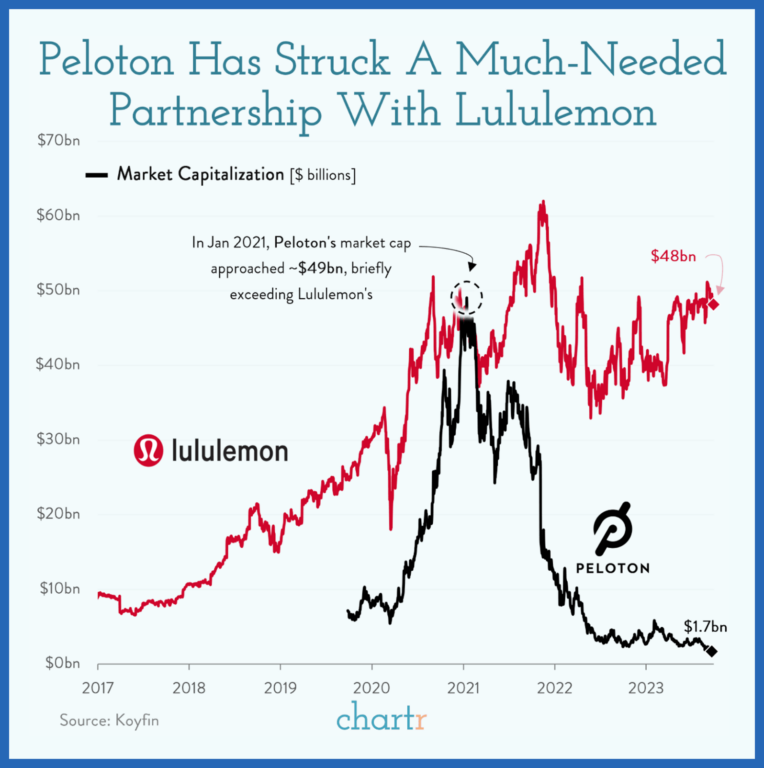
While the strategic partnership is likely to bring co-branding value to both companies, it is effectively an admission of failure by Lulu in regards to its USD$500-million acquisition of Mirror—another at-home smart fitness device—in 2020. With Lulu discontinuing sales of Mirror earlier this year in order to make room for the new Peloton partnership, one could assume there will now be a long-term truce in the two companies’ legal battle.
Stock bust: The worst of the worst
We’ve previously looked at the best-performing stocks. But now let’s look at the worst stocks of the last 100 years.
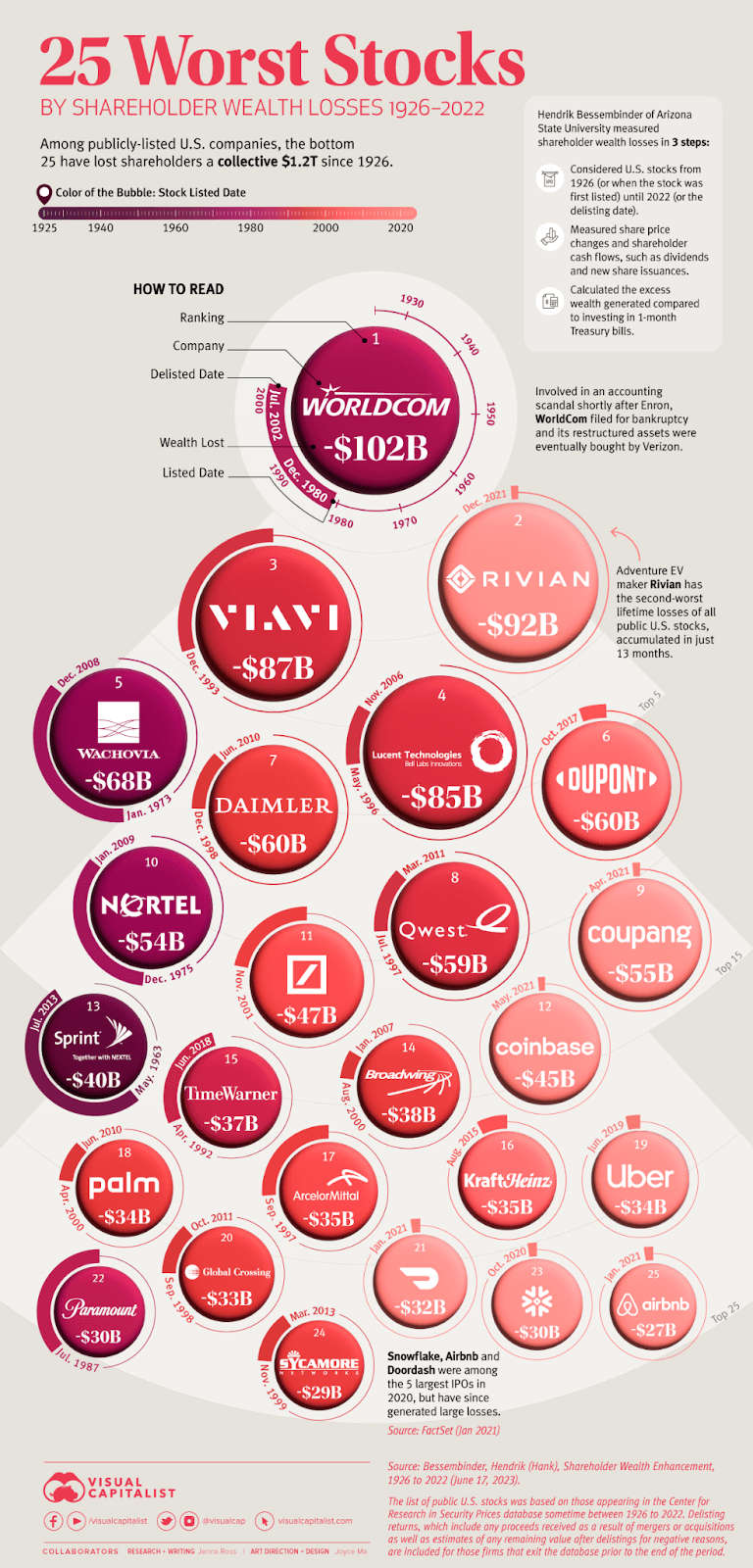
The above Visual Capitalist graphic shows the 25 worst stocks in the U.S.A. to have owned between 1926 and 2022. These companies have collectively lost shareholders USD$1.2 trillion over the last 100 years (14% of all shareholder losses).
Canadians, no doubt, recognize homegrown disappointment Nortel Networks (NRTLQ) on the left. It was once Canada’s largest company—at one point, it made up a remarkable 35% of the Toronto Stock Exchange. For context, today, Apple (AAPL), Microsoft (MSFT), Alphabet (GOOGL), Amazon (AMZN) and Meta (META) together make up 23% of the S&P 500.
Even with its gargantuan losses, Nortel only ascends to the number 10 spot. The heavyweight champ of evaporating shareholder value is WorldCom (WCOM). Before becoming embroiled in a massive accounting scandal, WorldCom was a long-distance telephone phone company. It declared bankruptcy in July 2002.
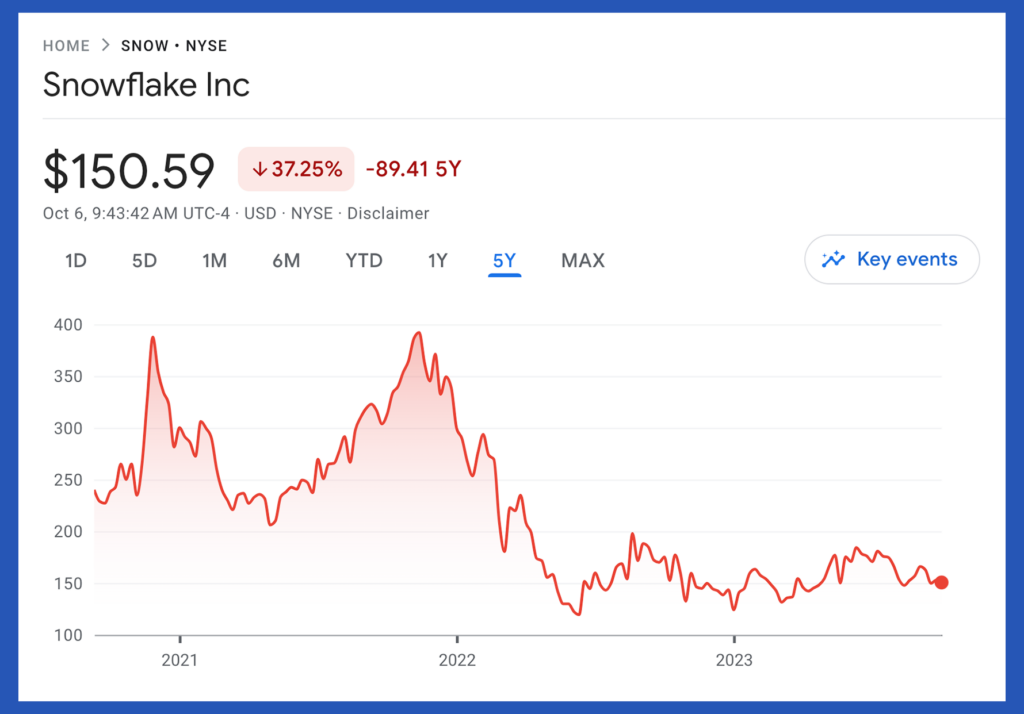
You might also have noticed that many of the most recent tech initial public offerings (IPOs) have prominent spots on this list. While companies like Uber (UBER) and Airbnb (ABNB) may eventually reward shareholders, they have yet to justify their lofty initial share prices. Cloud-based data company Snowflake (SNOW)—based in Bozeman, Montana—may never recapture its former glory, as it faces more and more competition in the tech industry.
Meanwhile, Doordash (DASH) shareholders might be forgiven for wondering if their company will ever produce profit over a 12-month span. Crypto aficionados are, of course, predicting Coinbase (COIN) will mount a comeback any day now. Coinbase lost USD$2.6 billion in 2022, so we’re sure the magical turnaround is just around the corner.
Modelo sales power Constellation Brands earnings
The Mexican beer and spirits company Constellation Brands (STZ/NYSE) announced positive earnings results on Thursday. Earnings per share came in at $3.70 (versus $3.36 predicted) and revenues were $2.84 (versus $2.82 predicted). (All numbers in this section are in U.S. dollars.)
While the earnings numbers are impressive, it appears that the market had already priced in a fair degree of optimism, and share prices were down 3.2% on the day.
Constellation continues to ride the wave of Modelo Especial taking market share from Bud Light this year. It is currently the best-selling beer in the U.S.
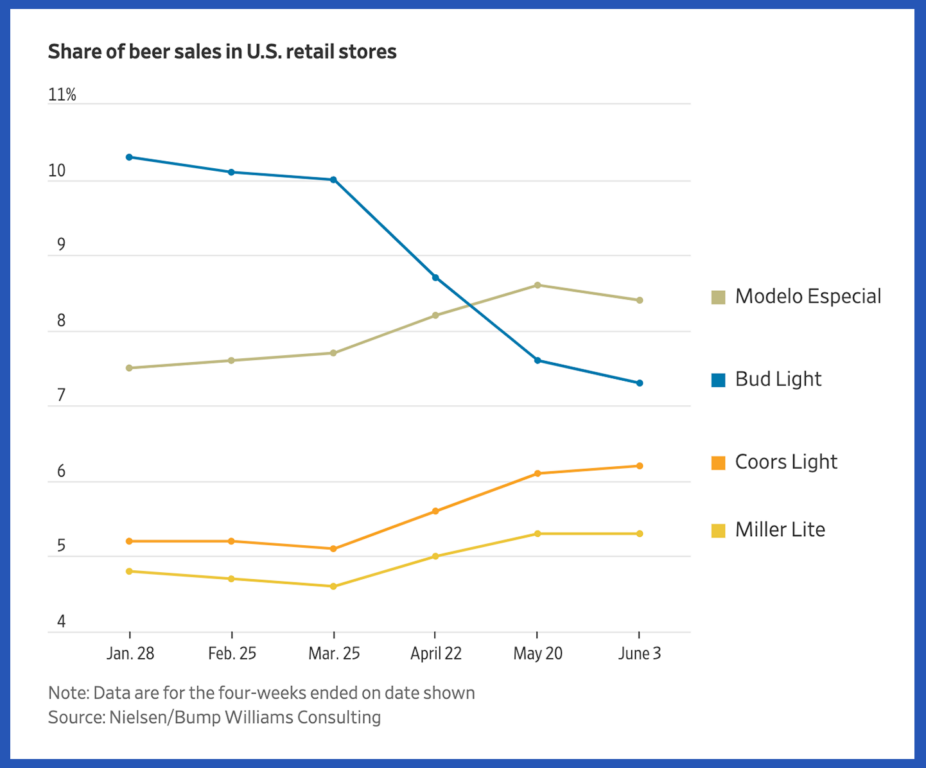
Earlier this year, the VP of brand marketing for Modelo, Greg Gallagher, stated, “We introduced Modelo Especial into the U.S. in 1982 and it has grown double digits in 37 of 41 years, which is kind of incredible.”
What would the entire world’s stock market look like?
Visual Capitalist is back at it, showing us the makeup of the entire world’s stock markets.
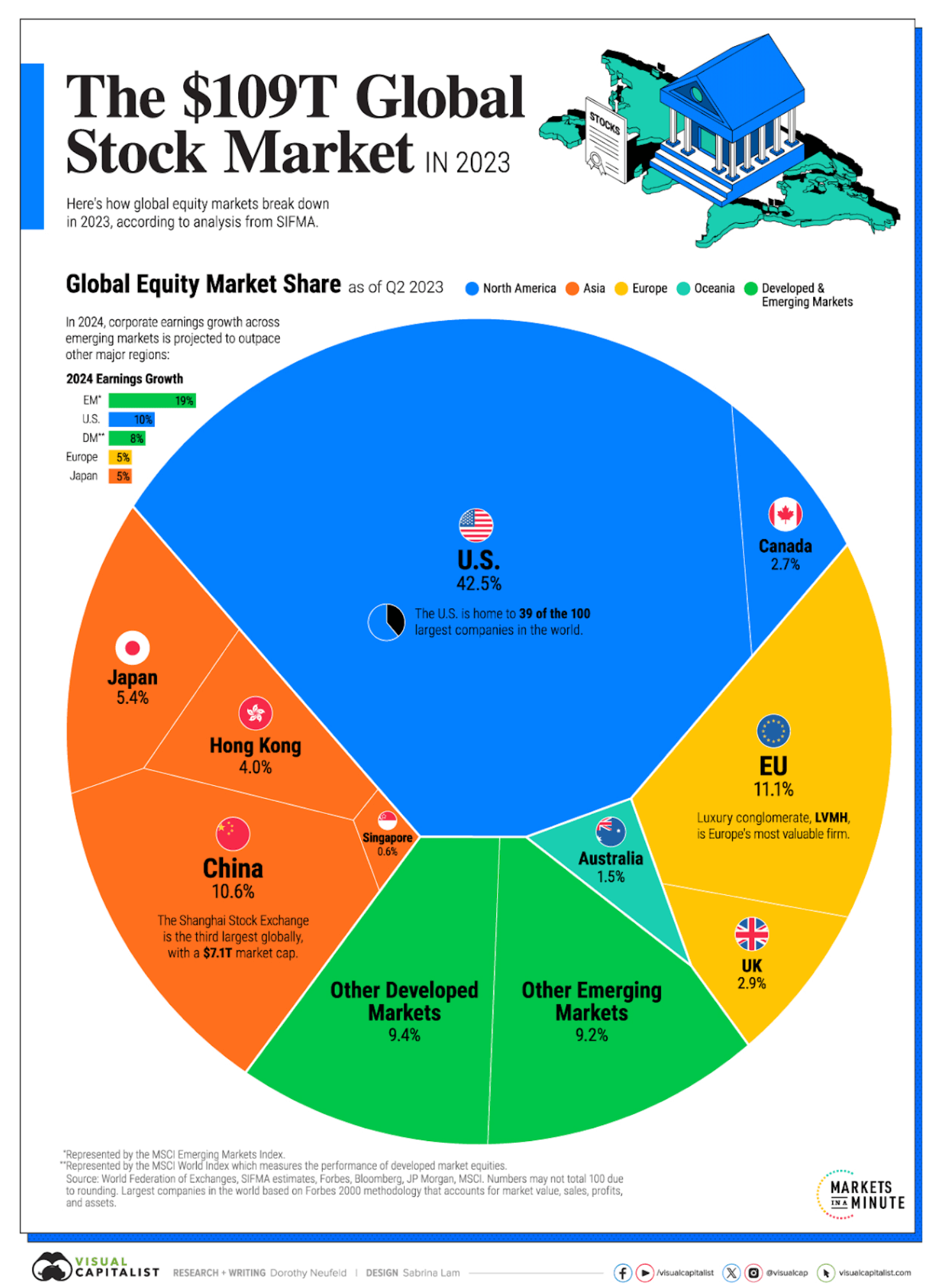
World market highlights
Some interesting points to note:
- If Visual Capitalist had been around making infographics like this one in 2003, it would show a world market worth only one-third of the USD$109 trillion we see today.
- The U.S. stock market has been on fire over the past few decades, with investors from 1990 seeing a 20-fold return on their investments.
- Relative to the rest of the developed world, the U.S. stock market has realized 400% higher returns.
- Canada’s stock market represents only 2.7% of the publicly traded stock universe (not even a tenth of the market share that the U.S. markets command).
- While China’s economy has increased 12-fold over the last 20 years, its equity markets have not kept up. After inflation, an investment in Chinese equity markets would have roughly broken even since 1993.
The article under the infographic goes on to forecast that increased economic growth will lead to emerging markets like China and India surpassing the U.S. share of equity markets by 2050. Given recent history, I’m not so sure about that. Increased economic growth doesn’t necessarily lend itself to fabulously profitable companies. After all, Apple doesn’t only sell products in the U.S.
Remember, at one time, Japan was forecast to take over the shareholder world as well.
Yes, it’s free: The Canadian Financial Summit
In case you missed it, we released the 2023 speaker lineup for the Canadian Financial Summit this past week, including sessions with familiar faces from MoneySense (see below). Registering for the Summit is completely free, and you can click here for more details.

Michael McCullough
Top Canadian ETFs for This Year and Beyond
With so many ETF options available, it can be hard for investors to know what to put into their portfolios. MoneySense’s executive editor, Lisa Hannam, hosts as journalist Michael McCullough looks at the makeup of the ETF market. He will share, based on MoneySense’s ETF All-Stars Report, the ETF products Canadians could consider buying today.
Allan Norman, MSc, CFP, CIM
All your FHSA questions answered
The first-home savings account is brand spanking new, and Canadians have questions. In the similar format of MoneySense’s popular Ask A Planner column, executive editor Lisa Hannam will ask Certified Financial Planner Allan Norman real questions from Canadians about the FHSA, from what it is to where to open this account.
Lisa Hannam
Personal finance trends to plan for in 2023 and 2024
MoneySense executive editor Lisa Hannam and columnist Kyle Prevost work together on the popular column Making Sense of the Markets. It contextualizes headlines for Canadian investors, so together the duo will be looking at the headlines from the year and those to come, including interest rates, crypto (remember that asset?), employment, AI, GICs and so much more.
The post Making sense of the markets this week: October 8, 2023 appeared first on MoneySense.
No comments