

What are the best Canadian ETFs for the Smith Manoeuvre?
In Canada, interest on money borrowed to purchase your principal residence is generally not tax-deductible. There is, however, an elaborate personal-finance strategy designed to gradually convert that non-deductible mortgage debt into potentially tax-deductible investment debt.
It’s called the Smith Manoeuvre. You start with a readvanceable mortgage, which combines a conventional mortgage with a home equity line of credit (HELOC). As you make each regular mortgage payment and reduce the principal, your available HELOC credit increases by a corresponding amount.
You then reborrow that newly available amount from the HELOC and invest it through a non-registered investment account. Provided the borrowed money can be directly traced to investments acquired for the purpose of earning income, the interest paid on that investment borrowing may generally be deductible as a carrying charge on line 22100 of your income tax return.
The Smith Manoeuvre therefore turns what would otherwise be ordinary mortgage repayment into a leveraged investment strategy. That leverage is also where the risk comes in. You’re borrowing against your home to invest in financial markets, and the HELOC balance remains outstanding regardless of whether your investments (or home price) rise or fall.
I would therefore consider a high risk tolerance, a long investment horizon, reliable cash flow and substantial diversification prerequisites before even considering the strategy. That last point makes exchange-traded fund (ETF) selection particularly interesting.
The harder question is which ETF makes the most sense. With that in mind, let’s look at the types of ETFs that may be best suited to the Smith Manoeuvre from both a risk and tax perspective.


Which ETFs are suitable from a risk perspective?
There are some important differences between a Smith Manoeuvre and conventional margin investing. A HELOC isn’t subject to the same daily margin requirements as a brokerage margin account, so a falling ETF price won’t automatically trigger a margin call requiring you to sell investments at precisely the wrong time. That removes one major risk associated with leveraged investing.
Still, I don’t think you need 100% equities to generate enough return to make the Smith Manoeuvre worthwhile. To illustrate this, I ran a Testfolio backtest comparing a globally diversified 60% equities/40% fixed income portfolio, represented by the iShares Core 60/40 Balanced Allocation ETF (AOR), leveraged to 150%, against an unleveraged 100% global equity portfolio represented by the Vanguard Total World Stock ETF (VT).
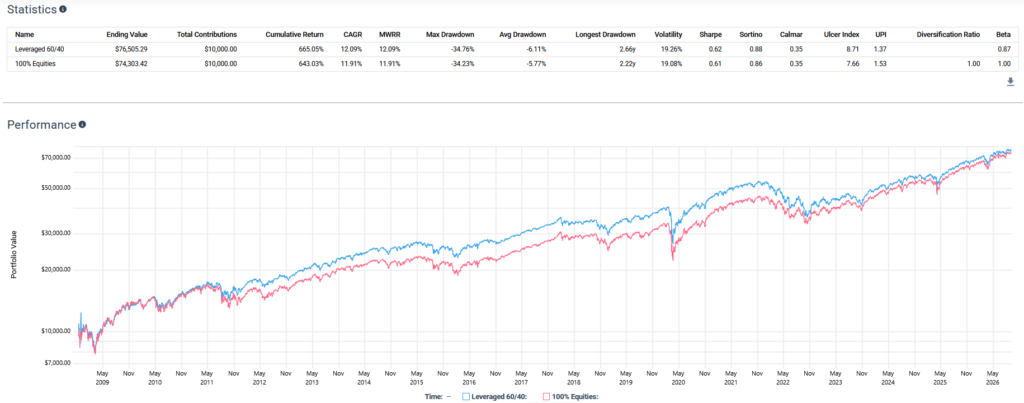
Source: Testfolio
What it demonstrates is that, historically, a diversified 60/40 stock-and-bond portfolio can be levered to approximately the same risk level as 100% equities, while producing a modestly higher return. Diversification is the only free lunch in investing, as the late Harry Markowitz would say, and using leverage smartly (like through tax-deductible interest from the Smith Manoeuvre) makes it even better.
One Canadian-listed ETF that could work here is the Vanguard Balanced ETF Portfolio (VBAL). It allocates 60% to equities and 40% to fixed income, holds tens of thousands of securities across Canada, the U.S. and international markets, and charges a 0.17% management fee. VBAL has produced a five-year annualized total return of 7.67%.
Investors hoping to cover their HELOC interest entirely from ETF distributions won’t get there with VBAL. Its trailing 12-month yield is only around 2.1%, considerably below the 4.95% HELOC rate Ratehub is quoting for my area right now. I don’t think that’s necessarily a problem because total return matters more than yield. You could just pay the outstanding interest from employment income.
Which ETFs are suitable from a tax perspective?
For the Smith Manoeuvre, the investments themselves also need to satisfy the Canada Revenue Agency’s income-earning purpose test. Something like VBAL should have little difficulty generating investment income. Its underlying stocks produce dividends, while its bonds generate interest income.
In a non-registered account, however, its distributions can contain different components. Canadian stocks can generate eligible dividends, international stocks can produce foreign income, bonds generate interest, and turnover can result in capital gains distributions. There can also be return of capital (ROC).
ROC is where the Smith Manoeuvre can become more complicated. The Canada Revenue Agency therefore generally doesn’t treat ROC as immediate taxable income. Instead, it reduces the adjusted cost base (ACB) of the investment, potentially deferring taxation until the ETF is eventually sold. You’ll need to track this!
Once ACB reaches zero, subsequent ROC distributions are generally treated as capital gains. That treatment can be useful in an ordinary non-registered portfolio. With borrowed money, however, you need to pay considerably more attention to what happens to that cash.
If an ETF distributes ROC and you withdraw that money for personal spending, a portion of the borrowed money may no longer be traceable to an income-producing investment. That can potentially affect the deductibility of the corresponding HELOC interest. Reinvesting the ROC or applying it against the loan can help preserve the tracing relationship, so this is where careful record-keeping becomes important.
From an administrative perspective, I’d personally prefer an ETF that generates little or no ROC. That generally points toward straightforward Canadian equity index strategies rather than high-yield income ETFs heavily reliant on covered calls. Avoiding international stocks also eliminates foreign income and associated withholding tax, while avoiding real estate investment trusts (REITs) can simplify the mix because REIT distributions can contain ordinary income and ROC.
One example I’m fond of is the Vanguard FTSE Canadian High Dividend Yield Index ETF (VDY). It charges a reasonably low 0.22% fund expense ratio (FER is the new, more inclusive measure of fund costs mandated by regulators and adopted by the industry), explicitly excludes REITs, and currently pays a trailing 3.12% 12-month yield. More importantly, its 2025 year-end tax characteristics were relatively straightforward, consisting mostly of eligible dividends and a minimal ROC component.
| Year | Eligible dividends | Non eligible dividends | Other income | Capital gains | Return of capital | Foreign income | Foreign tax paid | Total distribution per unit |
| 2025 | $2.19840 | $0.00000 | $0.00000 | $0.76462 | $0.00151 | $0.00000 | $0.00000 | $2.96453 |
Source: Vanguard Canada
That’s a fairly clean distribution profile for a Smith Manoeuvre. Eligible Canadian dividends receive preferential tax treatment through the dividend tax credit, there is effectively no foreign-income component to complicate matters, and the tiny amount of ROC minimizes the tracing and ACB issues.
Get your priorities straight
Still, I wouldn’t let the tax tail wag the investment dog. VDY may have a cleaner tax profile than VBAL, but it is considerably less diversified. You’re concentrated entirely in Canadian equities, with particularly large exposure to sectors such as financials and energy. You lose VBAL’s U.S., international and emerging-market equities, along with its fixed-income allocation.
A useful exception could be if you’re deliberately practising asset location across multiple accounts. If your RRSP or TFSA already hold your U.S., international developed, emerging-market, and fixed-income allocations, you could dedicate the non-registered Smith Manoeuvre portfolio primarily to Canadian equities such as VDY. Viewed at the household portfolio level, you could still maintain broad diversification while placing eligible Canadian dividend income in the taxable account
However, I’d still treat tax efficiency as one input rather than the primary objective. The ideal ETF for the Smith Manoeuvre needs to produce qualifying investment income and avoid unnecessary tax complications, but it also needs to be diversified enough that you can realistically hold it through a prolonged bear market while continuing to service the HELOC.
Overall, I’d say VBAL (or something like it) is a reasonable choice for executing the Smith Manoeuvre with VDY as an option for special situations.
Get free MoneySense financial tips, news & advice in your inbox.
Read more about investing with ETFs:
- What are “.U” ETFs? A guide to Canadian-listed U.S.-dollar ETFs
- Dividend ETFs make you money, just not for the reasons you think
- Are currency-hedged ETFs a good idea?
- What Canadian investors need to know about ETF closures
The post What are the best Canadian ETFs for the Smith Manoeuvre? appeared first on MoneySense.
No comments